

Message of the Week
Little White Community Church
Scripture: I Tim. 2: 1- 8
Aug. 9, 2026
Message: “One Mediator but Many Prayer Warriors!”
By Pastor George Gnade

Introduction:
1. As most of you know, we have begun a new series on the Book of I Timothy, and today we are considering one of the best passages about prayer.
2. In I Tim. 1:5 & 19, Paul emphasizes the value of a good conscience and a sincere faith. Then bracketed between these verses, he reminded us of our sinful natures and the many ways in which we fall, followed by his own testimony of how Jesus saved him from his own sinful past.
a. In vs. 15, he wrote: “Christ Jesus came into this world to save sinners of whom I am the worst.”
b. Then in vs. 16, he explained why: “But for this very reason, I was shown mercy so that in me, the worst of sinners, Christ Jesus might display His unlimited patience as an example for (others like me) who would (come) to believe in and receive eternal life.”
3. In plain words, Jesus saved him and helped him to change his life. After receiving Christ, his conscience became more responsive and his faith more meaningful. That is exactly what Paul desired to offer to people like you and me.
4. Now in chapter two, Paul does something similar. This time he brackets the value of prayer, emphasized in vs. 1 & 8, with even more good news about the Lord Jesus. Let’s look at these verses more carefully this morning.

A. Let us begin with Paul’s instruction about prayer.
1. In vs. 1, Paul wrote: “I urge then, first of all, that requests, prayers, intercession, and thanksgiving be made for everyone.” That is how important prayer is! There are no exceptions! Every person, whether good or bad, needs our prayers. There are four different ways to pray.
a. The general meaning of a “prayer request” is any need that is of concern to us. That is very broad. It shows that God cares about all of our needs.
b. But the next word used is “prayer.” That normally means this prayer is especially important to God Himself. For example, if we mess up and need forgiveness that is a specific concern that only God could answer.
c. The third word for prayer used in I Tim. 2:1 is a “petition.” This implies you are entering into a king’s presence to make your request. It means God is your king and you are humbly coming to ask help from Him. It meant you would approach Him with a sense of reverence. Obviously, Christians should certainly come before God with a sense of reverence.
d. Finally, Paul mentions “thanksgivings.” If we would count and give thanks for our blessings before we shared all our complaints, it would have a powerful effect on how we prayed and how we lived.
2. Having told us how to pray and how everyone needs our prayers, Paul then gets very specific. The most important persons who need our prayers are “kings and those in authority”(vs. 2). Rome had some very wicked kings. That was all the more reason to pray for them. He tells us to pray that those under their authority “may live peaceful, quiet lives in all godliness and holiness.”
a. The government has a lot to do with the freedom we have as Christians to practice our faith. So Paul encourages us to pray very specifically about that.
b. But notice how our prayer life is meant to affect us! As we prayer for them, Paul asks us “to live holy, godly lives.” The sins of our leaders are no excuse for us to lower our standards and disobey the Lord. The goal is to aim higher to please the Lord.
3. Now I already mentioned how “a good conscience and a sincere faith” in I Tim. 1:5 & 19 bracketed a discussion about our salvation. In I Tim. 2: 1 & 8, Paul goes even deeper and does something similar.
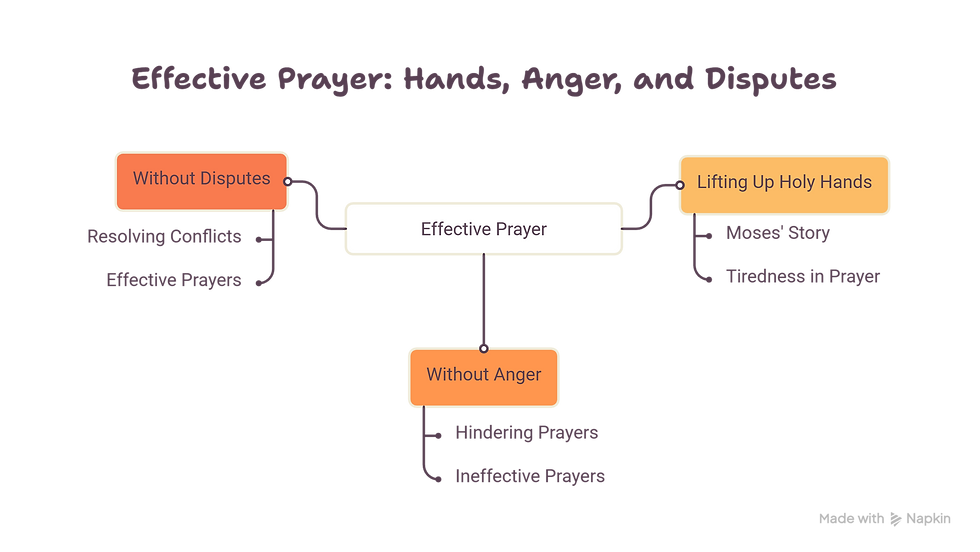
B. Let us consider I Tim. 2:8 first. Paul wrote: “I want men everywhere to lift up holy hands in prayer, without anger or disputing.”
1. Having told us to pray and how to pray in vs. 1-2, verse 8 creates the bracket by stressing prayer again.
a. Lifting up holy hands reminds us the story of Moses who asked two men to hold up his hands in prayer while Joshua fought and defeated their enemy (Ex. 17: 8-13).
b. This story also illustrates how we often get tired of praying while the need is still there. Every time Moses stopped the enemy made ground. So he asked for help.
2. I Tim. 2:8 also mentions praying “without anger or disputing,” two common problems that hinder our prayers and often keep us from praying effectively.

C. Having stressed the importance of prayer, even for our enemies, Paul uses vs. 3-7 to explain more about Jesus.
1. Vs. 3-4 say: “This is good and pleases God our Savior, who wants all men to be saved and come to a knowledge of the truth.” So we should prayer for everyone because God wants to draw as many as possible to Him. Anger and arguing only get in the way.
2. Then comes the gospel message in vs. 5-6: “There is one God and one mediator between God and man, the man Christ Jesus who gave Himself as a ransom for all.”
a. In I Tim. 1:15, Paul told us Jesus “came into this world to save sinners.” Now he explains more. Jesus did this by giving Himself “as a ransom for people every-where.”
b. Man’s sin needed to be punished. Jesus, God’s only begotten Son, came and paid the ransom for us by dying on the cross. In the process, He became the mediator between God and us.
3. We can pray for each other but we can’t save each other.
Only the Lord Jesus can save us. We must come to God through Him. As it says in Acts 16:31, “Believe on the Lord Jesus Christ and thou shalt be saved- you and your household.”
a. In plain words, this salvation through Christ was not just for men like the jailer; it was for his wife and children and even his slaves – anyone and everyone who would believe in the Lord Jesus and accept Him into their hearts and live their lives to please Him could be saved.
b. Remember the bracket! We are to pray for all men and live godly lives to draw all kinds of people to the Lord.
But it is all about the Lord Jesus Christ.
c. By grace He called and saved a sinner like Paul and offers the same salvation to you and me. He came and lived and died on the cross as our mediator. Then He rose from the dead never to die again as proof that He accomplished the mission His Father sent Him to do.
In conclusion:
1. In I Tim. 2:7, Paul says to this end “he was appointed” to share this wonderful good news with everybody. And everybody who receives this good news is to share it with others so that the whole world may know the truth of the Gospel.
2. As in chapter one, so again in I Tim. 2, it is all about Jesus who gave His life for us. Now He asks us to do our part. Developing a good conscience and a godly life and praying for everyone in a loving way are all for the same purpose. It is to lift Jesus higher and use our lives to point people to Him.
3. Assuming you have become a Christian, don’t forget who you are and what Jesus now asks you to do. Having been saved by grace ourselves, let us now offer this same gift of grace to others. Amen!



From Mr Leo Dkhar ,Meghalaya,
Through Leban Serto on the sermon for 9th August.
Thank you brother Leban for sharing. I have jotted down these sweet words from the gospel messages you have shared to me.
• _The words I gathered: _1 Timothy 2:1 Paul wrote: “I urge then, first of all, that requests, prayers, intercession, and thanksgiving be made for everyone._
• _Paul mentions “thanksgivings.” If we would count and give thanks for our blessings before we shared all our complaints, it would have a powerful effect on how we prayed and how we lived._
• _If we can live according toTim. 2:8 first. Paul wrote: “I want men everywhere to lift up holy hands in prayer, without anger…