

Message of the Week
The Little White Community Church
Scripture: I Tim. 6 : 1-10
September 27, 2026
Message: “Godliness with Contentment!”
by Pastor George Gnade

Introduction:
1. Today we are continuing our study of Paul’s first letter to Timothy. In Chapter 6, it begins with the controversial advice Paul gave to Christians who were slaves or masters over slaves.
2. In our day, most would have liked Paul to tell us how wrong slavery was. He never does that in any of his letters.
A. Consider the advice that he consistently gave to the Christian slaves and their masters (I Tim. 6:1-2).
1. In Phil. 2:6-11, Paul shared how Jesus “did not count equality with God something to be grasped, but He emptied Himself and took the form of a servant.” That is how He lived while on this earth.
a. To be consistent with what He did, He taught us that the greatest in the kingdom of heaven were to live in obedience to the Lord and as the servants of others.
b. Of course, no one did this better than Jesus who humbled Himself even to death on the cross so He could save you and me. Therefore, He has been given the greatest position with the greatest reward in heaven.
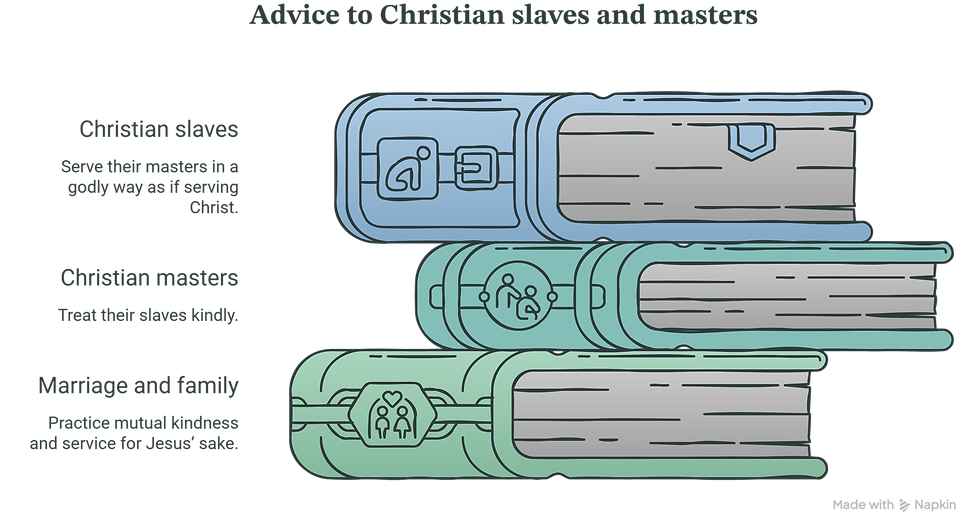
2. Therefore, a slave didn’t have to be set free from his master in order to get a great reward. All he was asked to do was serve his master in a godly manner as if he were serving Jesus Himself. Jesus would reward him for living a life of love and obedience.
a. This style of living would be so different and loving that non-Christians would want the love of Jesus they saw in the Christian slave and by God’s grace come to believe in Him too. That is exactly what happened.
b. Likewise, the master who was a Christian was to treat his slaves as if he were serving the Lord. By treating them kindly, they would see the difference in their master and be more willing to serve him.
c. This advice is consistent with what Paul told Timothy in I Tim. 6:1-2.
3. The same principle could be applied to marriage and family relationships. If husbands did their best to be godly, kind and loving to their wives and if wives did their best to be kind and loving to their husbands, children would be blest by having parents who loved Jesus and humbled themselves as if serving Jesus.
a. But of course, this is contrary to our human nature. The world wants power and often works in evil ways. They often call evil good and good evil. Non-Christians often demand their own way. Sadly, many times Christians do too. That does not make it right.
b. Living a godly life and serving each other for Jesus sake is only possible when you ask Jesus to forgive you and give you the Holy Spirit. Then with the help of the Holy Spirit, you can learn to live the Christian life like Jesus did.
c. But the more we learn to live like Him and serve others like He did, the greater our reward will be in heaven.
B. That brings us to I Tim. 6: 3-4 where Paul begins by addressing false doctrine.
1. The world wants and expects us to live like the world. They also want to ignore the clear teachings of Scripture.
a. All we know about God and the Lord Jesus Christ comes from the Bible.
b. God constantly warns us that a true Christian is to learn to believe and live according the Bible.

2. Every letter that Paul wrote differentiated between worldly philosophies and the teachings of the Bible.
a. Since a person is saved by believing in the Lord Jesus Christ, clearly what we believe has to be consistent with the Scriptures.
b. As it says in I Tim. 6:3-4, “If anyone teaches false doctrines and does not agree to the sound instruction of our Lord Jesus Christ and to godly teachings, he is conceited and understands nothing…”
3. The most popular philosophy in Paul’s day was Gnosticism. They loved to get people into arguments and once they got them confused by their ideas, many were led astray (I Tim. 6:4-5).
4. One such concept is that “godliness is a means to financial gain” (vs.5b). This is still a popular idea in our day. Basically they teach that if you have enough faith, you can ask for almost anything you want. If you give generously, God will make you rich.
a. This distorts what the Bible teaches. Many Christians have been very poor but rich in their faith.
b. While God does bless a generous giver, it may not be with money. Even when He does bless us financially, it is so that we can be generous and a blessing to others, not so we can have the biggest house and the fanciest car.
c. In fact, Paul warns us in vs.10 that “the love of money is the root of all evil.” Greed is not a virtue. We must be careful that the more we make, the more we spend, especially when it means the more we spend on ourselves.
5. What God does teach us in I Tim. 6:6 is that “godliness with contentment” is great gain.
a. In vs. 7-8, Paul goes so far as to say: “We brought nothing into the world and we can take nothing out of it. But if we have food and clothing, we should be content with that.”
b. This is followed by the warning in vs.9: “People who want to get rich fall into temptation and a trap and into many foolish and harmful desires that plunge men into ruin and destruction.
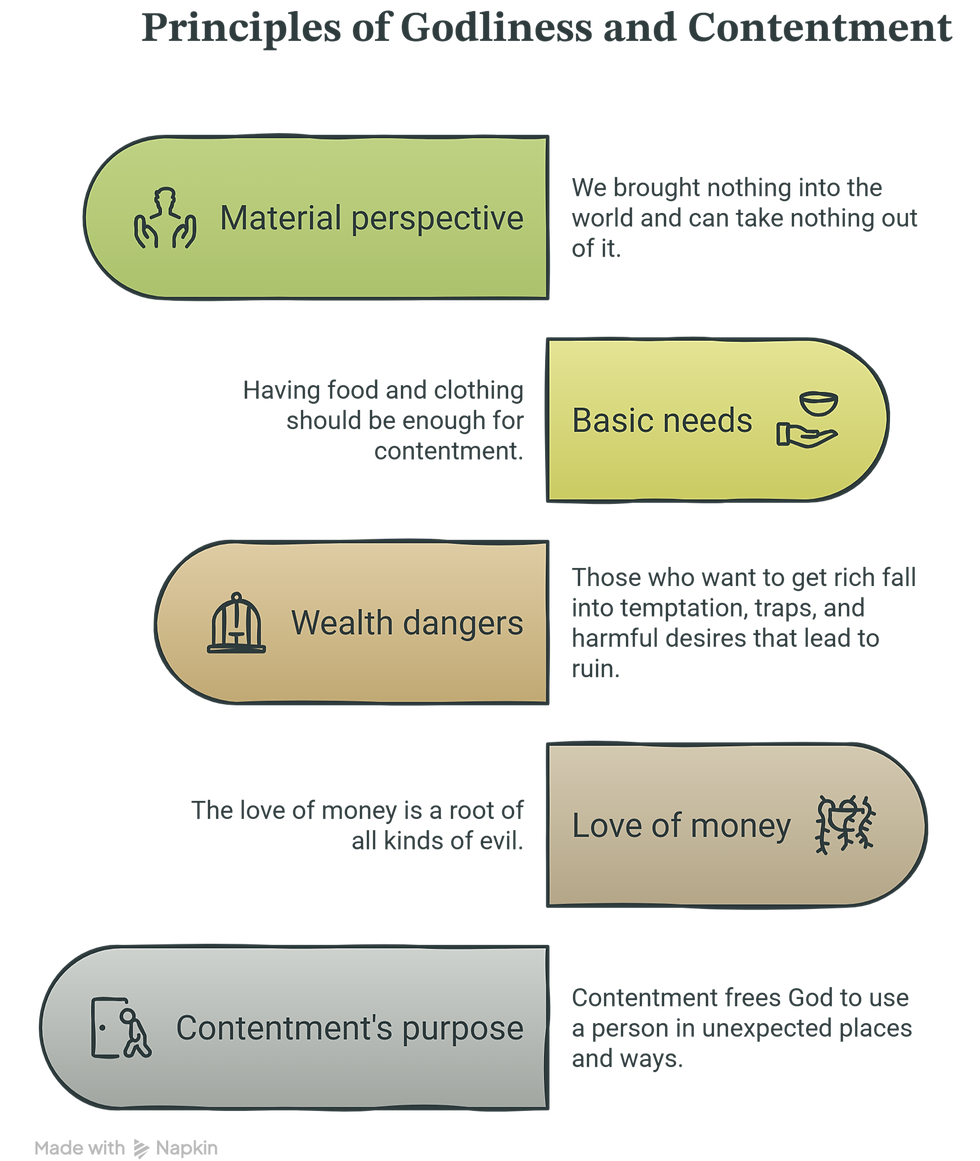
6. In fact, vs. 10 adds: “Some people, eager for money, have wandered from the faith and pierced themselves with many griefs.”
a. Demas was a man who was committed to the Lord who “fell in love with this present evil world” (II Tim. 4:10). It appears that money and worldly pleasure became more important to him than the Lord.”
b. Be careful that you are not so involved in making money and having fun that the Lord gets squeezed out of your life.
7. But “godliness combined with contentment is a great gain” (I Tim. 6:6). If we learn to live to please the Lord and learn to be satisfied with what we have, it frees God to use us in ways you never would have picked for yourself.
a. A friend of mine recently had to go and live in an assisted care center. At first she was very unhappy. But she also began to care for others in the home who couldn’t help themselves.
b. While she would have preferred to die and go to be with the Lord, she suddenly began to realize that God wanted to use her right where He had planted her.
c. It reminds me of Phil. 4: 11-13 where Paul wrote: “I am learning to be content regardless of the circumstances. I know what it is like to be in need, and I know what it is like to have plenty. I have learned the secret of being content in any and every circumstance, whether well fed or hungry, whether living in plenty or want. I can do all things through Christ who strengthens me.”
In conclusion:
1. There is one more thing that needs to be said. It is not unusual for God to bless some more than others. Now I am referring to people like you and me compared to other Christians, especially Christians in other parts of the world.
2. Paul has some very specific advice for us. In I Tim. 6: 17-19, Paul says: “Charge those who are rich in this world’s goods not to be proud and not to set their hope on this world’s riches, but on God who gives them all things to enjoy. Charge them to do good and to be rich in noble deeds by being generous and willing to share. That way they will lay up for themselves a firm foundation for the coming age, so they may take hold of the life that is truly life.”

3. We must never forget that we are part of the fellowship of believers, not only in our own church, but as part of the fellowship of believers all over the world. We need to pray and care for each other as God leads us. Amen!




Thank you 🙏🏻 pastor