

Message of the Week
The Little White Community Church
Scripture: I Thess. 2:1-12 Feb. 1, 2026
Message: “The Praise of Men or of God?”
By Pastor George Gande

Introduction: 1. As most of you know, we have begun a new series of messages on Paul’s first letter to the Thessalonians.
a. In I Thess. 1, we learned about the genuineness of their new found faith in Christ.
b. In fact, they were so deeply moved by the Holy Spirit that they had not only accepted Christ as their Savior, but were so full of joy that they told everybody about it.
2. In light of that, I Thess. 2: 1 makes an understatement. He writes: “You know, brethren, that our visit to you was not a failure.” But when we consider how it happened, it easily could have been considered a failure.
a. Paul had been in Philippi where he and Silas were thrown in prison, whipped, and placed in stocks simply because they had told them about Jesus.
b. But God sent an earthquake that literally set them free. When the Philippian jailor found out, he was about to kill himself for fear of what would happen to him for losing his prisoners.
c. But Paul stopped him and went on to share Christ with him. In fact, one of the most well-known passages in the Bible is found in Acts 16:30-31 where the jailor asked Paul: “What must I do to be saved? They replied: “Believe on the Lord Jesus Christ and you will be saved, both you and your household.”
d. So what looked like a bad experience in Philippi, turned into a good one.
3. As Paul wr0te in I Thess. 2:2: “We had previously suffered and been insulted in Philippi … but with the help of our God, we (came to you and) dared to tell you this gospel…”
a. The problem was, some of the same people who gave them trouble in Philippi, followed them and immediately caused “strong opposition” in Thessalonica too.
b. Was that because Paul was a failure? Not at all! In truth, God often works in spite of our hardships.
A. Consider how Paul defends himself and what he and his helpers were doing.
1. In I Thess. 2:3, he writes: “The appeal we made (to you) did not spring from error or impure motives, nor did we try to trick you.”
a. Clearly, Paul wants them to know that he and his helpers were not to blame.
b. In vs. 4, he continues: “On the contrary, we spoke as men approved by God to be entrusted with the gospel.”
2. As a pastor, it is critical that I do my best to live worthy of this privilege. And in all honesty, it is equally important for you too. All of us should share Christ so the church will grow. Therefore, we all need to ask forgiveness for the faults in our lives and seek, with Jesus help, to aim higher.

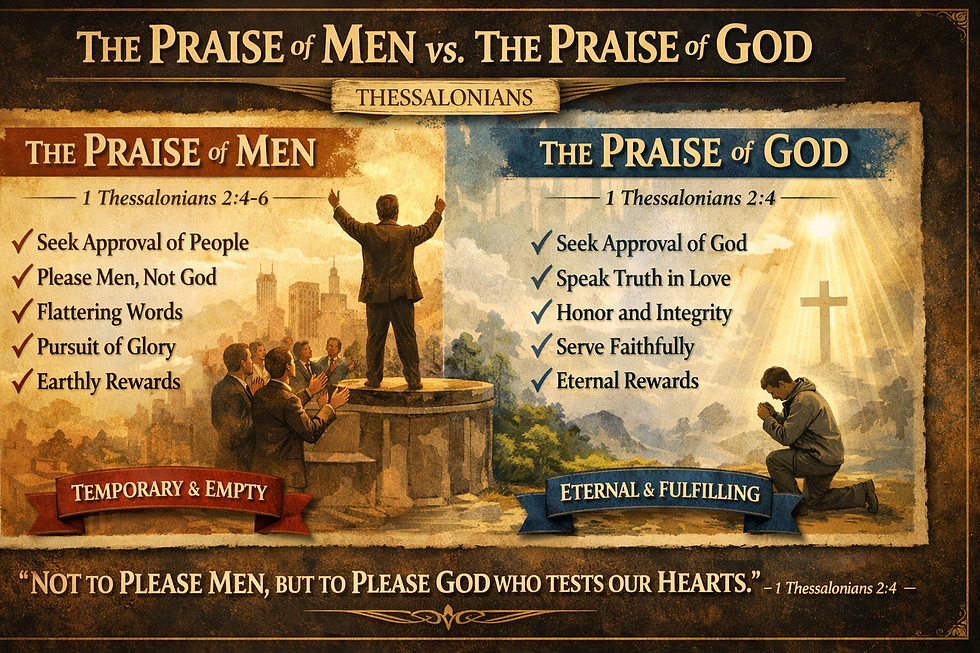
B. But that is not all. Paul also warns us of the danger of trying to please other people when God calls us to please Him.
1. In I Thess. 4:4b, he writes: “We are not trying to please men but God, who tests our hearts.”
a. Let us be honest with each other. Who does not appreciate a compliment?
b. In order for a pastor to reach out to you or others, he has to build a bridge of trust.
2. But Paul is warning us, especially pastors, how careful we must be to preach the truth of God’s Word and not water it down to please the world around us.
a. To be kind is one thing. But to compromise the Word of God is another.
b. Because Paul would not compromise his faith in Christ is exactly what got him into trouble. Jews who did not believe in Jesus followed him everywhere he went and attacked or threatened his work for the Lord.
3. We must remember that before Paul was confronted on the road to Damascus by Jesus Himself, Paul was doing exactly what his present enemies were doing.
a. If your friends or loved ones do not believe in the Lord, they could turn on you.
b. So it takes courage to share your faith in the hope of winning them to Jesus. Let’s be honest, Christians all over the world must face this problem.
4. In plain words, Paul was not being attacked for doing wrong. But he was being attacked because of his love for the Lord Jesus Christ. That is exactly why he wrote: “We are not trying to please men but God, who tests our hearts” (I Thess. 2:4).
C. Thirdly, Paul takes this a step farther. In vs. 5, he writes: “You know we never used flattery, nor did we put on a mask to cover up greed.”
1. Our world loves to use flattery before trying to sell us their products. Often, it is a way to make money off of us.
a. Many pastors preach what people want to hear so they will give more to the church.
b. Paul wanted the Thessalonians to know he was not after their money.
2. Paul set high standards for himself for this very reason.
a. He allowed churches who knew about his ministry to support him, just as we do through our mission budget.
b. But whenever he was ministering to people on his missionary journeys, he worked as a tent maker and supported himself.
3. Listen to what he wrote in I Thess. 2:9. “Surely you remember, brethren, our toil and hardship; we worked night and day in order not to be a burden to anyone while we preached the gospel to you.”
a. Much earlier in my ministry, Carol and I started to sell vitamins on the side to make a little extra. It did not take long before people thought I was using my role as a pastor to grow our business. That was not true, but it gave that appearance. So we stopped.
b. My friends, the gospel is a free gift Jesus offers to anyone who will choose to accept Him into their lives and live for him. Never forget salvation is a gift of God’s grace, not of works, lest anyone should boast (Eph. 2:8-10).
D. Finally, Paul reminds them of what he did do.
1. In vs. 7-8, he wrote: “We were gentle among you, like a mother caring for her children. We loved you so much that we were delighted to share with you not only the gospel of God but our lives as well, because you became so dear to us.”
2. And again in vs. 10-11, He wrote: “You are witnesses, and so is God, of how righteous and blameless we were among you who believed. For you know that we dealt with each of you as a father deals with his own children, encouraging, comforting, and urging you to live lives worthy of God who calls you into His kingdom and glory.”

In conclusion: 1. Paul’s relationship with these new Christians in Thessalonica explains how we should reach out to others and how we should treat others, especially those who love the Lord.
2. In the process, he also warned of things we should avoid doing like flattering them and using them or even pleasing them instead of standing up for Jesus. May God enable us to do our best for Him so we can win souls too. Amen!



Good sermon, Pastor George!